Our technology
The Atomic Cluster Expansion and its initial software implementation were developed at the Ruhr University Bochum. ACEworks makes this technology readily available for industrial applications, providing corresponding services.
Atomic cluster expansion (ACE)
The Atomic Cluster Expansion (ACE) is a powerful mathematical framework that enables quantum-accurate predictions of atomic interactions at a numerical cost several orders of magnitude smaller than that of electronic structure calculations. ACE is highly versatile, able to represent popular neural network potentials and kernel methods.
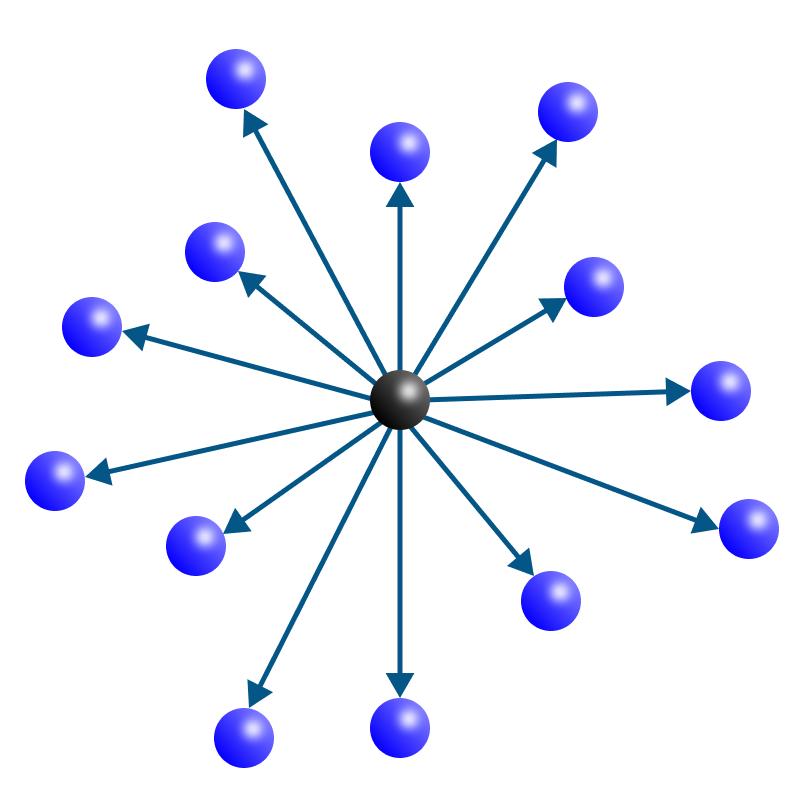
Graph atomic cluster expansion (GRACE)
In its generalization to incorporate graphs, Graph ACE (GRACE) comprises equivariant message-passing graph neural networks, including the multi-ACE and ml-ACE variants of the ACE family of machine learning interatomic potentials.
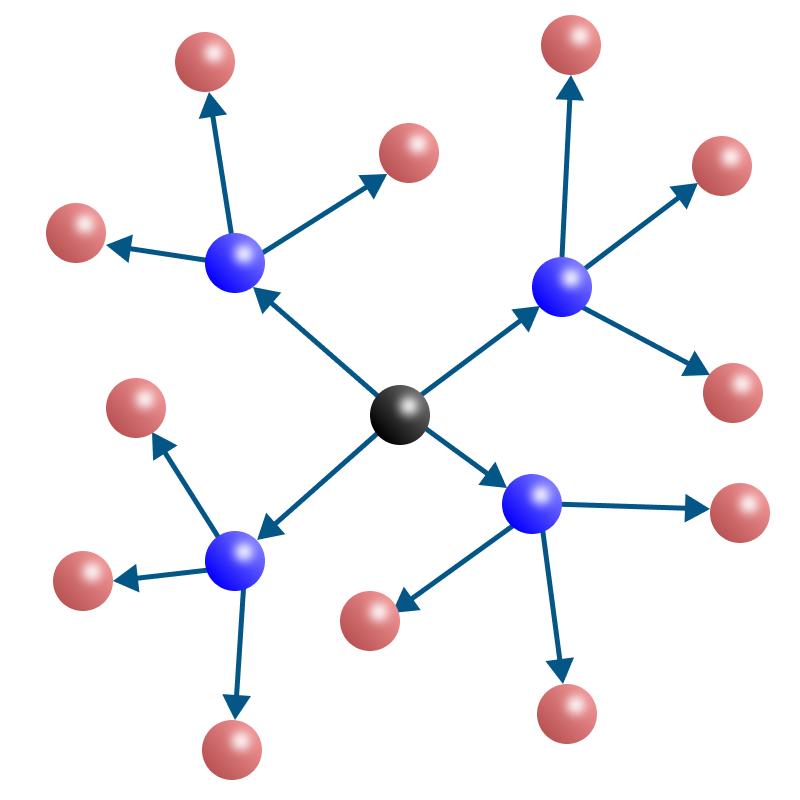
Software implementation
We have implemented specialized software for the efficient training and evaluation of ACE-family machine learning interatomic potentials. Our software has been demonstrated to provide Pareto-optimal accuracy and numerical efficiency for demanding atomistic simulations.
Key features
Quantum accuracy at large scales
Achieves mean absolute errors (MAE) in energy and forces comparable to reference ab initio data, enabling predictive modeling of material properties.
Systematic convergence
Unlike neural network potentials that act as black boxes, ACE provides a systematically improvable basis set, allowing users to control the trade-off between accuracy and computational cost by truncating the expansion order.
Multi-component capability
Can be used for simulations of complex multicomponent systems, handling 5+ element systems without the combinatorial explosion of parameters.
Active learning support
ACE models provide reliable uncertainty quantification, facilitating active learning loops that automatically identify and request DFT calculations for high-uncertainty configurations.
Production-ready efficiency
Optimized for performance in standard MD codes such as LAMMPS, capable of simulating millions of atoms on CPU/GPU architectures with nanosecond/day throughputs.