Solvents and solutions
ACE allows for efficient evaluation and clear interpretation of many-body interactions, which are critical for describing the hydrogen-bond network of water. ACE potentials have been parameterized to model water for broad pressure-temperature conditions (up to 100 GPa and 6000 K). These models accurately capture the equation of state and complex phase boundaries, including the transitions between molecular fluid, insulating ice VII, superionic ice phases (VII and X), and dissociated plasma phases. Capturing the subtle energy differences between ice polymorphs and liquid water.
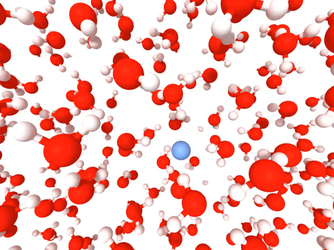
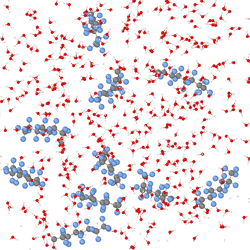
Beyond bulk water, ACE frameworks have been successfully applied to other molecular systems, including small organic molecules such as ethanol or polyethylene glycol, accurately reproducing energies and forces while maintaining stability during MD simulations. Furthermore, modeling dissolution of molecules and ions in water and other solvents provides detailed insights into the energetics and structural changes involved in solvation, such as the formation of hydration shells around ions and the hydrogen bonding networks in aqueous solutions. By accurately capturing the dynamic behavior of solvent-solute interfaces, researchers can predict solubility, diffusion coefficients, and reaction mechanisms that are difficult to observe directly through experimental techniques alone.