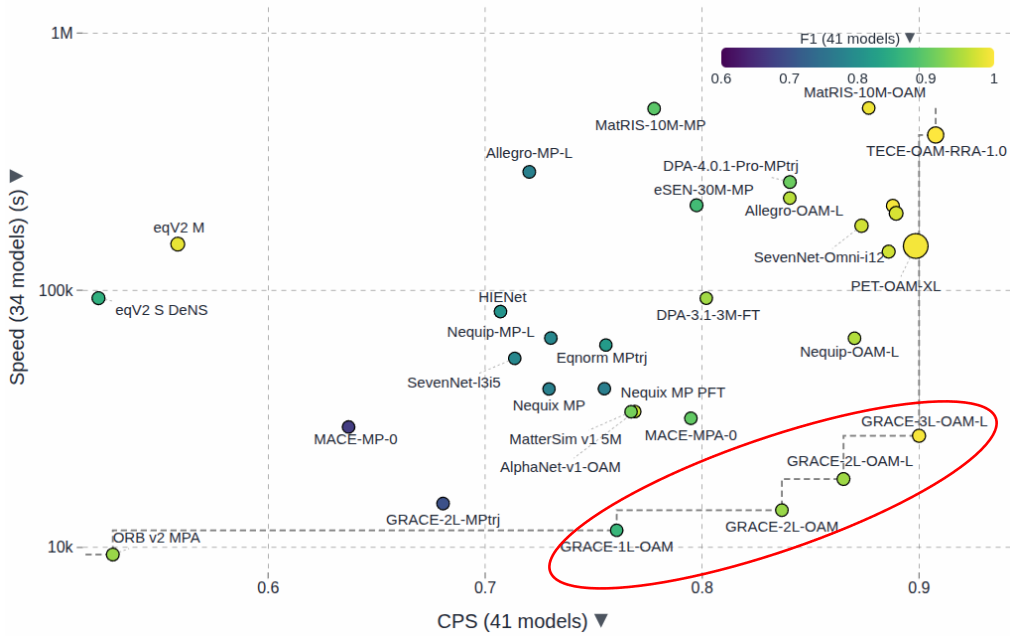
GRACE-3L, the newest member of the GRACE family, among the best MLIPs
The latest GRACE-3L-OAM-L model developed by Anton Bochkarev and Yury Lysogorskiy delivers outstanding accuracy and genuinely fast inference, placing it #4 on the Matbench Discovery leaderboard. GRACE models push the accuracy-vs-speed Pareto front a step further again.
Learn more
General-Purpose Machine-Learned Force Fields in Theory and Practices
Yury Lysogorskiy was an invited speaker at the workshop General-Purpose Machine-Learned Force Fields in Theory and Practice at the University of Luxembourg. This workshop brought together researchers developing and applying general-purpose machine-learned force fields for atomistic simulations in chemistry and materials science.
Learn more
Foundational GRACE: Towards quantum accuracy in atomistic modeling of materials
Matous Mrovec was an invited speaker at the conference Machine Learning in Chemical and Materials Sciences 2026 in Santa Fe, NM, USA. This conference series is organized annually by the Los Alamos National Laboratory and gathers scientists interested in applying machine learning models for atomistic simulations. The main focus this year was on foundation models for molecular and materials design, uncertainty quantification, and agentic workflows.
Learn more
ACEworks and Materials Design to continue their successful collaboration in the field of Machine-Learned Potentials
ACEworks and Materials Design are rolling forward their successful collaboration with the full integration of the GRACEmaker code of ACEworks in the MedeA computational environment. The GRACEmaker code is based on the Graph Atomic Cluster Expansion (GRACE), one of the most advanced methods for the generation of Machine-Learned Potentials (MLPs). MedeA 3.12 provides comprehensive support of the leading GRACE 1L and 2L potentials in MedeA LAMMPS. This includes access to the most recent Foundational GRACE potentials GRACE-1L-OMAT, GRACE-2L-OMAT, GRACE-1L-OAM, and GRACE-2L-OAM, which cover 89 chemical elements.
Learn more
GRACE — Bedrock for Foundational Machine Learning Interatomic Potentials
Ralf Drautz was an invited speaker at the MRS 2025 Fall Meeting in Boston, USA. MRS belongs to the world’s foremost international scientific gatherings for materials research, that showcases leading interdisciplinary research in both fundamental and applied areas presented by scientists from around the world.
Learn more
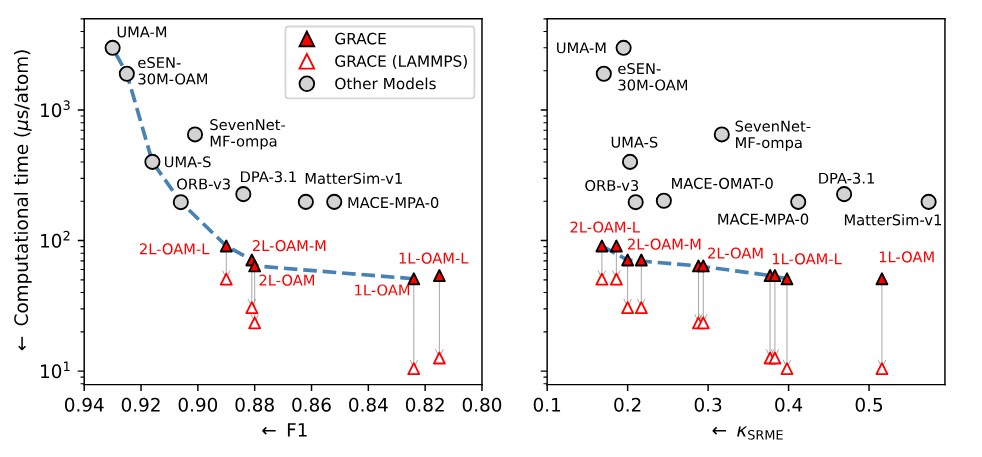
GRACE defines the Pareto front of universal ML models
Foundational machine learning interatomic potentials that can accurately and efficiently model a vast range of materials are critical for accelerating atomistic discovery. We introduce foundational GRACE potentials, trained on several of the largest available materials datasets. We demonstrate that the GRACE models establish a new Pareto front for accuracy versus efficiency among foundational interatomic potentials.
Learn more

ACEworks Presents at Materials Design MedeA User Group Meeting
Ralf Drautz was an invited speaker at the 2025 Materials Design MedeA User Group Meeting. This event brought together users of the MedeA software platform, a popular tool for materials design and simulation.
Prof. Drautz demonstrated the new series of GRACE foundational interatomic potentials.
Learn more
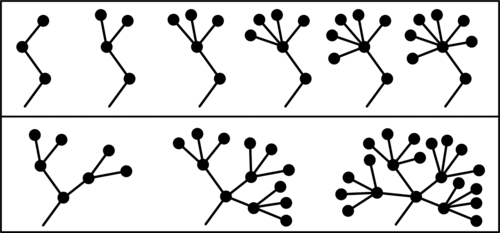
GRACE paper published in Physical Review X
The fundamental paper on the graph atomic cluster expansion (GRACE) which incorporates graph basis functions. This naturally leads to representations that enable the efficient description of semilocal interactions in physically and chemically transparent form. Simplification of the graph expansion by tensor decomposition results in an iterative procedure that comprises current message-passing machine learning interatomic potentials.
Learn more
ACEworks Sponsors MMM-11 Conference in Prague
ACEworks is excited to announce their sponsorship of the “Machine Learning Assisted Materials Discovery” symposia on the MMM-11 conference, taking place in Prague from September 22nd to 27th, 2024. The symposia will explore the latest methods and applications of machine learning for all aspects of materials discovery, from representing materials to developing accurate property prediction models.
ACEworks is committed to supporting advancements in this field. We look forward to connecting with attendees at the conference and showcasing our latest solutions. Learn more

ACEworks Presents at Materials Design MedeA User Group Meeting
Ralf Drautz, CEO of ACEworks, will be speaking at the 2023 Materials Design MedeA User Group Meeting. This event brings together users of the MedeA software platform, a popular tool for materials design and simulation.
Drautz’s presentation is expected to delve into the fundamental principles behind ACE models and showcase a comprehensive overview of their current applications in materials science research.
Learn more
MedeA 3.7 to Offer Support for ML-PACE
Exciting news for materials scientists! Starting from the MedeA 3.7 release, scheduled for April 2023, support for performant implementation of ACE machine-learning interatomic potentials (ML-PACE) in LAMMPS will be included.
Learn more