Hydrogen in materials
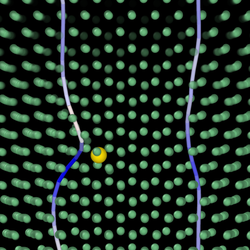
Capturing the complexity of hydrogen interacions with materials – particularly its rapid diffusion, reactivity, and trapping – requires a balance of accuracy and computational speed that traditional atomistic models often fail to provide. ACE and GRACE potentials can be used to reveal how hydrogen diffusion into metallic materials, accumulates at grain boundaries and other crystal defects and it alters their intrinsic properties. These processes are intimately linked to material degradation known as hydrogen embrittlement. Using ACE for the ternary Al-Mg-H system, we have investigated these phenomena in complex microstructures of the Al-Mg alloys.
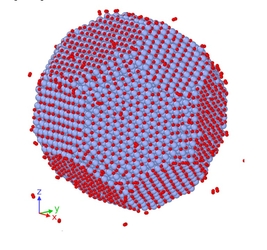
Simulations can further clarify how hydrogen interacts with surfaces of various metals, thereby affecting their chemical activity – for instance, during the hydrogen evolution reaction. Recent ACE simulations showed that a lattice expansion due to absorbed H enhances the catalytic performance of Pd surfaces. Furthermore, the thermodynamics of hydrogen interaction with palladium nanoparticles depends sensitively on te particle size and shape leading to a distinct hysteresis scaling law. ACE simulations provide understanding how surface-shell and core interactions govern H uptake storage and lattice distortions at the nanoscale.