Accelerating alloy discovery
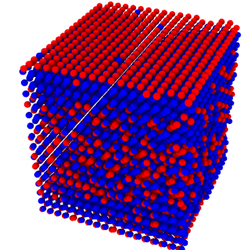
The efficiency of ACE interatomic potentials enables a shift from static structure calculations to large-scale, dynamic atomistic simulations that mimic experimental realities. This enables to simulate systems comprising many thousands of atoms, allowing for the direct observation of microstructural evolution. This includes capturing critical phenomena such as dislocation dynamics, grain boundary migration, and precipitate nucleation in realistic chemical environments. By bridging the spatial and temporal gaps between electronic structure methods and continuum models, these simulations provide a rigorous platform for investigating mechanical failure mechanisms, thermal stability, and phase transformations under operative conditions.
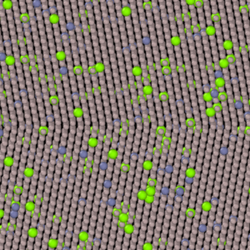
We have developed and rigorously validated ACE interatomic potentials for various metallic elements and alloys. These potentials represent a significant advancement over exisiting classical interatomic potentials, as they enable to perform large-scale atomistic simulations with accuracy close to that of ab initio methods. They hve been used in simulations of complex phase transformations, surface segregation in complex multicomponent alloys, morphologies of metallic nanoclusters and others.