Magnetic materials
Magnetic atomic cluster expansion enables to include atomic magnetic moments (spins) as active degrees of freedom. Unlike traditional models that treat atoms as simple points (classical potentials) or spins on a fixed lattice (Heisenberg models), Magnetic ACE can treat both atomic positions and magnetic spins simultaneously, allowing them to interact. We can therefore simulate atoms moving (vibrating/diffusing) and spins fluctuating (rotating/flipping) at the same time. This is critical for modeling materials at high temperatures where both structure and magnetism become disordered.
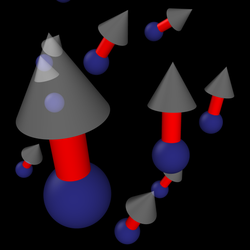
Iron is the prototypical ferromagnetic material whose structural stability depends entirely on its magnetism. Pure iron changes from a magnetic BCC structure (alpha-phase) to a non-magnetic FCC structure (gamma-phase) as it heats up. Standard classical potentials fail to predict this because they cannot account for the loss of magnetism. Magnetic ACE successfully reproduces this transition by coupling the vibrational entropy with the magnetic disorder.

ACE was recently used to model also the complex iron-oxygen system, which includes different iron oxides: Hematite, Wüstite, and Magnetite. These materials have complex magnetic arrangements (e.g., ferrimagnetism in Magnetite, where some spins point up and others down, but they don’t cancel out completely).